
How to Check Moles: The ABCDE Rule
Learn the ABCDE melanoma rule, how to do a monthly skin self exam, track mole changes, and know when to see a dermatologist.
By Doctor AI Team
Key Takeaways
- The ABCDE melanoma rule helps you spot mole changes that can signal melanoma and should prompt a professional skin check.
- Many organizations, including the **American Academy of Dermatology (AAD)**, recommend a regular head-to-toe skin self exam to notice new or changing spots.
- A mole that changes, bleeds, itches persistently, or won’t heal deserves medical attention, even if it looks “small.”
- Taking clear, repeatable photos and measuring with a ruler can make changes easier to confirm and explain at an appointment.
Checking your moles doesn’t have to be scary or complicated. A quick, consistent routine—and knowing what to look for—can help you catch meaningful changes early.
What the ABCDE Rule Is, and Why It Matters
The ABCDE rule is a simple checklist used to flag features that can be seen in some melanomas. Dermatologists use many tools to evaluate skin (including dermoscopy and biopsy when needed), but ABCDE is a practical way for you to notice concerning mole changes during a skin self exam.
According to the **American Academy of Dermatology (AAD)**, the ABCDEs are warning signs to look for in spots that might be melanoma. The **CDC ** and other public health agencies also promote awareness of changing moles as a key reason to get checked.
A: Asymmetry
A typical benign mole is often fairly symmetrical—if you imagine folding it in half, both sides look similar. Asymmetry means one half doesn’t match the other in shape, thickness, or pattern.
Practical tip: If you’re unsure, take a straight-on photo and use your phone’s editing tool to draw a line through the center to compare both halves.
B: Border
Benign moles often have smoother, more even edges. A concerning spot may have irregular borders—ragged, notched, blurred, or scalloped edges.
Practical tip: Look at the border under bright light. If the edge seems to “fade” into surrounding skin or looks jagged, add it to your watch list.
C: Color
Practical tip: Compare the spot to nearby moles. If it has more than one distinct color or a new color appears over time, document it.
D: Diameter
The “D” is often taught as diameter larger than about 6 mm (roughly the size of a pencil eraser). The AAD notes that melanomas are often larger than 6 mm when diagnosed—but they can be smaller.
Practical tip: Use a ruler (millimeters) or a coin for scale in photos. Track whether the spot is growing, not just its current size.
E: Evolving
Evolving may be the most important letter: any change in size, shape, color, elevation, or symptoms (like bleeding, crusting, or itching) can matter. The AAD emphasizes that change over time is a key warning sign.
Practical tip: Put a monthly reminder on your calendar. Consistency helps you notice change that’s easy to miss day-to-day.
How to Do a Monthly Skin Self Exam (Step-by-Step)
A skin self exam works best when it’s routine, thorough, and documented. The **AAD** describes a methodical head-to-toe approach so you don’t miss hard-to-see areas.
What you’ll need
- Bright lighting
- A full-length mirror and a hand mirror
- A chair or stool
- A hair dryer or comb (to part hair)
- Your phone for photos
- A ruler (millimeters) or measuring tape
Practical tip: Do your exam after a shower, when you’re already undressed and the lighting is good.
A head-to-toe checklist
- Face and scalp: Check your nose, lips, ears (front and back). Part hair in sections; use a hair dryer to move hair and see the scalp.
- Hands and arms: Palms, backs of hands, between fingers, under fingernails, wrists, forearms, elbows, and upper arms.
- Torso: Neck, chest, and abdomen. Women should lift breasts to check underneath.
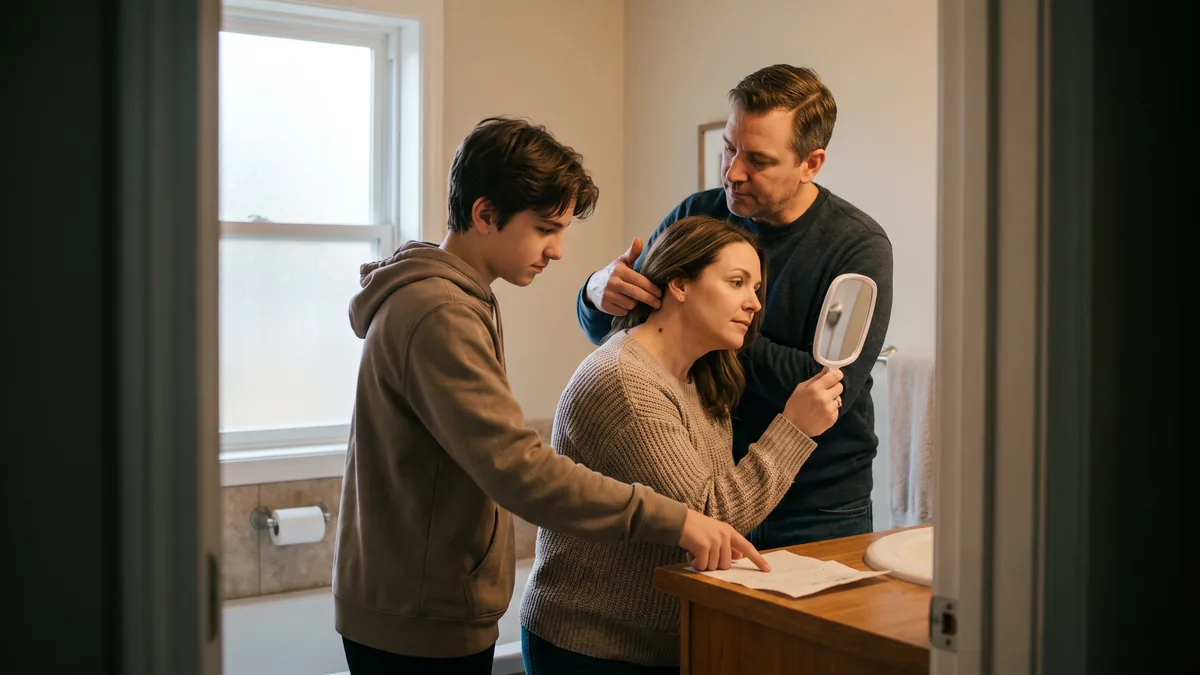
- Sides and back: Use a hand mirror for the back of the neck, shoulders, upper back, and lower back. Ask a partner for help if possible.
- Buttocks and genital area: Don’t skip areas that rarely see sun; melanoma can occur there too.
- Legs and feet: Front and back of thighs, shins, calves, ankles, tops and soles of feet, between toes, and under toenails.
Practical tip: If a partner helps, keep it consistent—same person, same lighting—so comparisons are easier month to month.
What “Normal” Looks Like: Common Benign Spots
Not every unusual spot is dangerous. Many people have a mix of freckles, moles, and other benign growths. Still, because melanoma can mimic harmless lesions, visual inspection alone can’t confirm what something is—only a clinician can do that.
Here are common non-cancerous possibilities doctors often consider:
- Common acquired moles (melanocytic nevi): Usually evenly colored and stable over time.
- Freckles (ephelides): Often darken with sun exposure and fade in winter.
- Seborrheic keratoses:** “Stuck-on,” waxy or warty growths, common with aging; the **NHS** notes they are benign, but can resemble melanoma.
- Cherry angiomas: Small, bright red vascular bumps.
- Dermatofibromas: Firm small bumps, sometimes after an insect bite; may dimple inward when pinched.
Practical tip: Instead of trying to label a spot, focus on ABCDE melanoma features and evolution. If it’s changing, photograph and get it assessed.

How to Track Mole Changes So Your Doctor Can Help
Clinicians make better decisions when they have a clear timeline: what changed, when, and how fast. A vague sense that “it looks different” is common—but you can turn that into useful information.
Use the “same-photo” method
- Take photos in the same location, same lighting, and same distance.
- Include a ruler (mm) or a coin for scale.
- Take two shots:
- Close-up (sharp focus on the spot)
- Context (show where it is on the body)
Practical tip: Create a phone album called “Skin check” and name photos by date and body site (e.g., “2026-09-14 left shoulder”).
Keep a simple change log
Track:
- Date first noticed
- ABCDE features present (if any)
- Symptoms: itching, tenderness, bleeding, crusting
- Any triggers: friction from clothing, shaving cuts, sunburn
Practical tip: Bring your photo timeline to appointments—it can help your clinician decide whether a lesion needs closer evaluation.
Know the “ugly duckling” sign
Many people have moles that look similar to each other. A spot that looks noticeably different from your other moles—the “ugly duckling”—can be worth checking. The AAD discusses this concept as another practical clue alongside ABCDE.
Practical tip: During each skin self exam, ask: “Does anything look unlike the rest of my spots?”
Who Should Be Extra Vigilant About Skin Checks?
Anyone can develop melanoma, but some factors increase risk. The **CDC** and **NHS ** describe higher-risk situations that warrant more attention and, often, professional screening discussions.
Higher-risk factors to discuss with a clinician
- Personal history of melanoma or other skin cancers
- Strong family history of melanoma
- Many moles or atypical moles
- History of intense sun exposure or blistering sunburns
- Use of indoor tanning devices (the **WHO** classifies UV-emitting tanning devices as carcinogenic)
- Immunosuppression (for example, after organ transplant or certain medications)
Practical tip: If any of these apply, ask your clinician how often you should have a professional skin exam and whether total-body photography could help.
Prevention: Protect Your Skin Without Overthinking It
Prevention is about reducing UV damage over a lifetime. The **WHO**, **CDC **, and **NHS ** consistently recommend sun-protective behaviors to lower skin cancer risk.
Everyday habits that make a difference
- Seek shade when the sun is strongest.
- Wear protective clothing: long sleeves, wide-brim hat, and UV-blocking sunglasses.
- Use broad-spectrum sunscreen and reapply as directed on the label, especially after swimming or sweating.
- Avoid indoor tanning.
Practical tip: Keep sunscreen next to your toothbrush or car keys so it becomes part of your leaving-the-house routine, like brushing or locking the door.
Don’t forget “hidden” UV exposure
UV exposure can add up during:
- Driving (sun through windows)
- Outdoor errands and sports
- Cloudy days (UV still penetrates clouds)
Practical tip: If you’re outside regularly, consider a lightweight UPF shirt or a sun hat as your “default,” then use sunscreen for exposed areas.
When to See a Doctor
These are situations where you should arrange professional medical assessment—ideally with a primary care clinician or a dermatologist—because they can’t be safely evaluated at home.
Make an appointment promptly if you notice:
- Any mole or spot that meets ABCDE melanoma criteria, especially E: evolving (new or changing).
- A new, unusual spot in adulthood that persists and doesn’t settle.
- A lesion that bleeds, oozes, crusts, or forms a sore that doesn’t heal.
- Persistent itching, pain, or tenderness in a mole without an obvious cause.
- A spot with multiple colors or a blue/black component you haven’t had before.
- A rapidly growing bump or patch, or a lesion that looks very different from your other moles (“ugly duckling”).
- A dark streak under a nail or pigment spreading onto the surrounding skin (around the nail fold).
Seek urgent care the same day if:
- A mole or skin lesion has significant bleeding that won’t stop with firm pressure.
- You have signs of infection in a skin lesion (spreading redness, warmth, pus, fever).
What to bring or ask at your visit
- Your photo timeline and change log.
- Ask: “Does this lesion need dermoscopy or biopsy?” and “How should I monitor my other moles between visits?”
- If you’re high risk, ask about a screening plan and whether total-body photography is appropriate.
Frequently Asked Questions
How often should I do a skin self exam?
Monthly is a practical schedule for many people because it helps you notice gradual mole changes. The AAD promotes regular self-checks and a consistent head-to-toe method. If you’re high risk, ask your clinician whether you should check more often.
Can a normal-looking mole still be melanoma?
Yes, melanoma doesn’t always look dramatic, and some can be small or subtle. That’s why E for evolving and the “ugly duckling” sign matter alongside ABCDE. If a spot is changing or symptomatic, it’s worth getting checked.
What if my mole itches but looks unchanged?
Itching can happen for benign reasons like dryness or irritation, but persistent itching is also a reason to ask a clinician to evaluate the spot. Document how long it lasts, whether it recurs, and whether there’s bleeding or crusting. If itching persists or the mole starts changing, arrange an appointment.
Should I remove a mole at home or with a kit?
No—home removal can miss a diagnosis and can lead to infection, scarring, or uncontrolled bleeding. Clinicians remove suspicious lesions in a way that allows proper lab examination, which is essential to rule out melanoma. If a mole bothers you or changes, book a medical evaluation.
External Links
- The ABCDEF Rule: Combining the “ABCDE Rule” and the “Ugly Duckling Sign” in an Effort to Improve Patient Self-Screening Examinations - PMC
- Mayo Clinic Q and A: Bleeding moles and skin checks - Mayo Clinic News Network
- Atypical moles: diagnosis and management. - Abstract
- When might a mole mean cancer? - Mayo Clinic News Network
- Clinical ABCDE rule for early melanoma detection - PubMed
- Many organizations, including the **American Academy of Dermatology (AAD)
- According to the **American Academy of Dermatology (AAD)
- Many harmless moles are a single shade of brown. Color variation—multiple shades (brown, black, red, pink, white, blue/gray) within the same spot—can be a warning sign for melanoma, according to the **AAD
- A skin self exam works best when it’s routine, thorough, and documented. The **AAD
- Seborrheic keratoses:** “Stuck-on,” waxy or warty growths, common with aging; the **NHS
- Anyone can develop melanoma, but some factors increase risk. The **CDC
- Use of indoor tanning devices (the **WHO
- Prevention is about reducing UV damage over a lifetime. The **WHO
- Monthly is a practical schedule for many people because it helps you notice gradual mole changes. The AAD


